Last reviewed: November 2026. This guide is for general information and is not medical advice. Talk to a qualified clinician about any treatment decision.
Rehabilitation is one of the most studied uses of virtual reality (VR) in healthcare. The research points to a modest, practical conclusion: VR helps mainly by getting people to do more therapy, not by replacing the therapist.
Key takeaways
- Stroke: a 2025 Cochrane review of 190 trials found slight gains in arm function and balance, and larger gains when VR was added on top of usual therapy.
- Parkinson’s disease: a Cochrane review found VR and conventional physiotherapy may have similar effects on walking and balance.
- Safety: side effects in trials were few and mild.
- Certainty: low to moderate. Many trials were small and used simple gaming systems.
In this guide
What VR rehabilitation involves
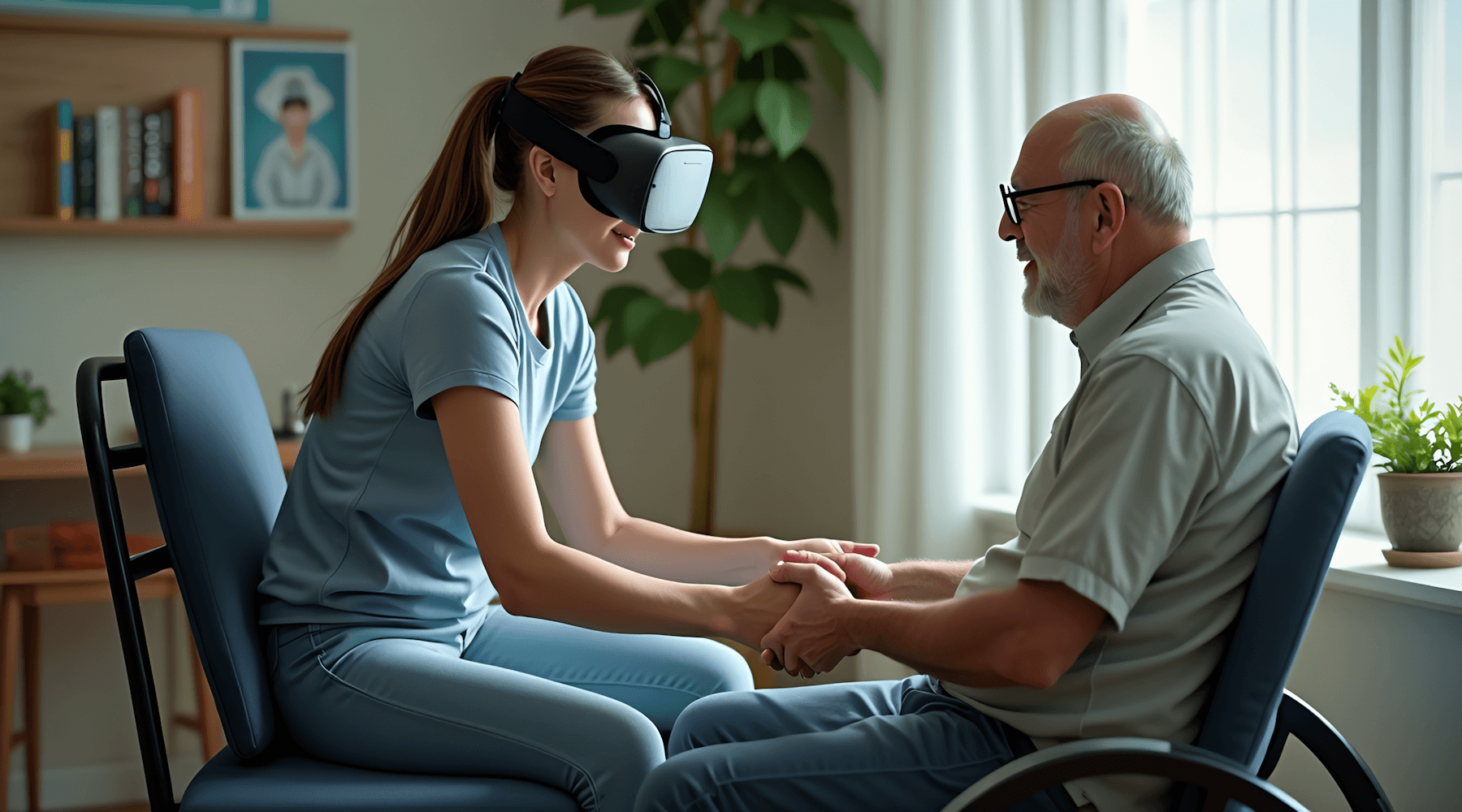
In rehabilitation research, “virtual reality” covers a wide range: from off-the-shelf motion games on a screen to immersive headsets built for therapy. In both cases the person practices movements, such as reaching, stepping or shifting weight, inside a game-like task that gives instant feedback and can be made gradually harder.
The appeal is repetition. Recovery of movement depends on a great deal of practice, and a game can make that practice more engaging and easier to do without a therapist present for every minute.
After stroke
The largest body of evidence is in stroke. A 2025 Cochrane review pooled 190 randomized trials involving 7,188 people. It found:
- Compared with the same amount of conventional therapy: a slight improvement in arm function, balance and everyday activity.
- Added to usual care: a moderate improvement in arm function, with likely benefits for balance and everyday activity. In these trials the VR group received more total therapy time.
- No clear effect on walking speed, participation in daily life or quality of life.
- Adverse events were few and mild.
The review’s authors also noted that most programs train movements in isolation. Few use VR’s ability to simulate real tasks, such as shopping or crossing a road, which would be unsafe to practice for real early in recovery.
Parkinson’s disease
The evidence here is thinner and older. A Cochrane review of VR for rehabilitation in Parkinson’s disease included 8 trials with 263 participants, searched up to November 2016. Most compared VR exercise with physiotherapy. The review found that the two may have similar effects on walking, balance and quality of life, with low-quality evidence that VR improved step and stride length. No adverse events were reported.
In plain terms, VR exercise looked like a reasonable alternative form of practice, not a better one, and the small number of participants means that conclusion could change with more research.
What VR adds, and what it does not
- It adds practice time. The strongest results come when VR is extra therapy, not a substitute.
- It can add motivation. Game-like feedback helps some people keep going with repetitive exercise.
- It does not replace clinical judgment. Choosing the right exercises and progressing them safely still depends on a therapist.
- Equipment varies widely. Results from a simple gaming console may not apply to a purpose-built medical system, and the reverse is also true.
Questions to ask
- Will VR be in addition to my usual therapy, or instead of some of it?
- Which movements or tasks is it meant to improve?
- Can I use it safely at home, and who checks my progress?
For the wider picture, see our guide to virtual reality in healthcare.
Common questions
Does VR help stroke recovery?
A 2025 Cochrane review of 190 trials found slight gains in arm function and balance, and larger gains when VR was added on top of usual therapy.
Does VR help with Parkinson’s disease?
A Cochrane review found VR and conventional physiotherapy may have similar effects on walking and balance.
Is VR rehabilitation safe?
Side effects in trials were few and mild. The certainty of the evidence is low to moderate, because many trials were small.
Sources
- Laver KE, et al. Virtual reality for stroke rehabilitation. Cochrane Database of Systematic Reviews, 2025.
- Dockx K, et al. Virtual reality for rehabilitation in Parkinson’s disease. Cochrane Database of Systematic Reviews, 2016.