
Last reviewed: November 2026. This guide is for general information and is not medical advice.
Virtual reality (VR) lets students and clinicians practice on simulated patients and procedures, where mistakes cost nothing. Trials suggest it improves test scores and simulator performance. Whether that carries through to better care for real patients is much less studied.
Key takeaways
- Knowledge: a review of 31 randomized trials found VR slightly improved knowledge scores compared with traditional teaching.
- Surgical skills: for keyhole gallbladder surgery, trainees with VR practice performed better and operated faster than those with no extra training.
- Against other simulators: the same analysis found no significant difference between VR and simpler simulation trainers.
- Gap: very few studies follow trainees into the operating room or measure patient outcomes.
In this guide
How VR is used in training
- 3D anatomy models that can be rotated and enlarged.
- Virtual patients for practicing assessment, decisions and communication.
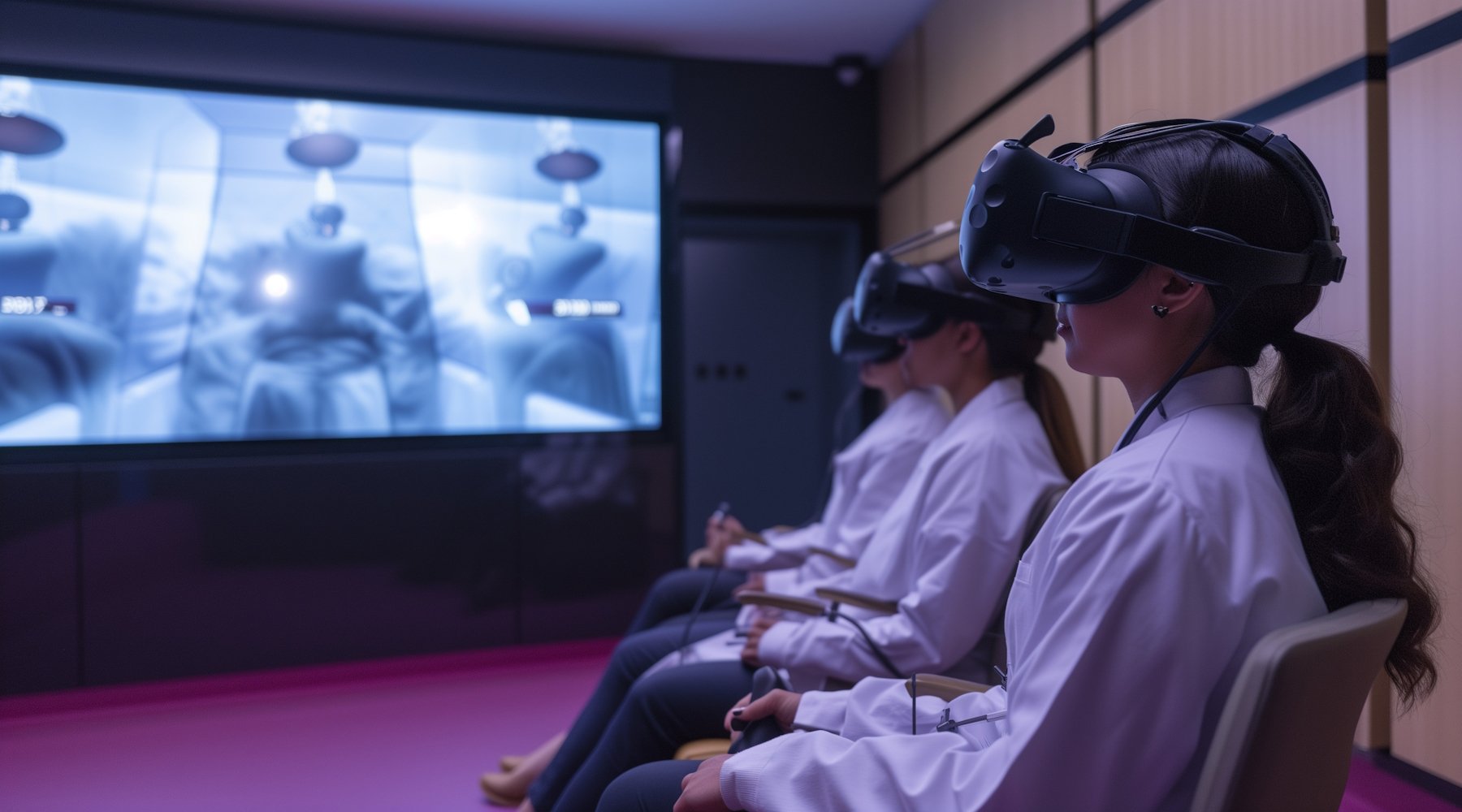
- Procedure simulators, from desktop keyhole-surgery trainers to fully immersive headsets that recreate an operating room.
Knowledge and clinical reasoning
The broadest summary is a 2019 systematic review by the Digital Health Education Collaboration, which covered 31 randomized trials and 2,407 health professionals and students.
- Knowledge: across 8 trials, VR produced slightly higher knowledge scores than traditional teaching, with moderate certainty.
- Cognitive skills: across 4 trials, VR showed a large advantage over traditional teaching, also with moderate certainty.
- What was missing: none of the trials reported patient outcomes, changes in how clinicians behaved, or unintended effects of VR. Findings on attitudes and satisfaction were mixed.
The review searched for studies up to August 2017, so it predates the current generation of standalone headsets.
Surgical skills
Keyhole (laparoscopic) surgery has the longest record. A 2008 review of randomized trials concluded that VR training can supplement standard laparoscopic training, and that for trainees with limited experience it reduced operating time, errors and unnecessary movements.
A 2022 meta-analysis in BJS Open looked at one operation, laparoscopic gallbladder removal, across 18 randomized trials. Junior trainees who had VR practice scored higher on a standard rating of operative skill and finished about eight minutes sooner than trainees with no additional training. Against other simulation methods, such as box trainers, there was no significant difference. The authors caution that the studies were small and varied in their methods.
In orthopedics, a 2021 review of 16 randomized trials with 431 participants found a statistically significant advantage for VR on 29 of 47 measured outcomes. Only two of the studies assessed trainees in a real operating room, and none measured patient safety.
Augmented reality in teaching
Augmented reality (AR) adds 3D images to the room the learner is standing in. Research here is at an earlier stage and mostly consists of single studies. In one, reported by Diagnostic Imaging, first-year medical students who reviewed head and neck anatomy as 3D holograms scored better on a follow-up test than students who used a flat screen.
Limits of the evidence
- Transfer to real care: most trials test learners on a simulator or an exam, not with patients.
- Small, varied studies: the orthopedic trials averaged about 27 participants each, and simulators, curricula and scoring differ from study to study.
- The comparison matters: VR looks strongest against no extra training and much less distinctive against other forms of simulation.
- Retention: the orthopedic review found no studies of how long skills last.
Questions to ask
- Has this simulator been tested against the training we already use, not just against no training?
- Is there evidence that skills learned on it show up in real procedures?
- How will it fit alongside supervised practice, which it supplements and does not replace?
Related guides: augmented and virtual reality in surgery and the wider picture of virtual reality in healthcare.
Common questions
Does VR training make surgeons better?
For keyhole gallbladder surgery, trainees with VR practice scored higher and operated faster than those with no extra training. Few studies follow trainees into the operating room.
Is VR better than other training simulators?
Not clearly. A 2022 meta-analysis found no significant difference between VR and simpler simulation trainers.
Does VR improve medical knowledge?
A review of 31 randomized trials found VR slightly improved knowledge scores compared with traditional teaching.
Sources
- Kyaw BM, et al. Virtual Reality for Health Professions Education: Systematic Review and Meta-Analysis by the Digital Health Education Collaboration. Journal of Medical Internet Research, 2019.
- Humm G, et al. The impact of virtual reality simulation training on operative performance in laparoscopic cholecystectomy: meta-analysis of randomized clinical trials. BJS Open, 2022.
- Systematic review of randomized controlled trials on the effectiveness of virtual reality training for laparoscopic surgery. British Journal of Surgery, 2008.
- Clarke E. Virtual reality simulation: the future of orthopaedic training? A systematic review and narrative analysis. Advances in Simulation, 2021.
- Diagnostic Imaging. Medical School Students Receive Augmented Training via Augmented Reality Headsets.